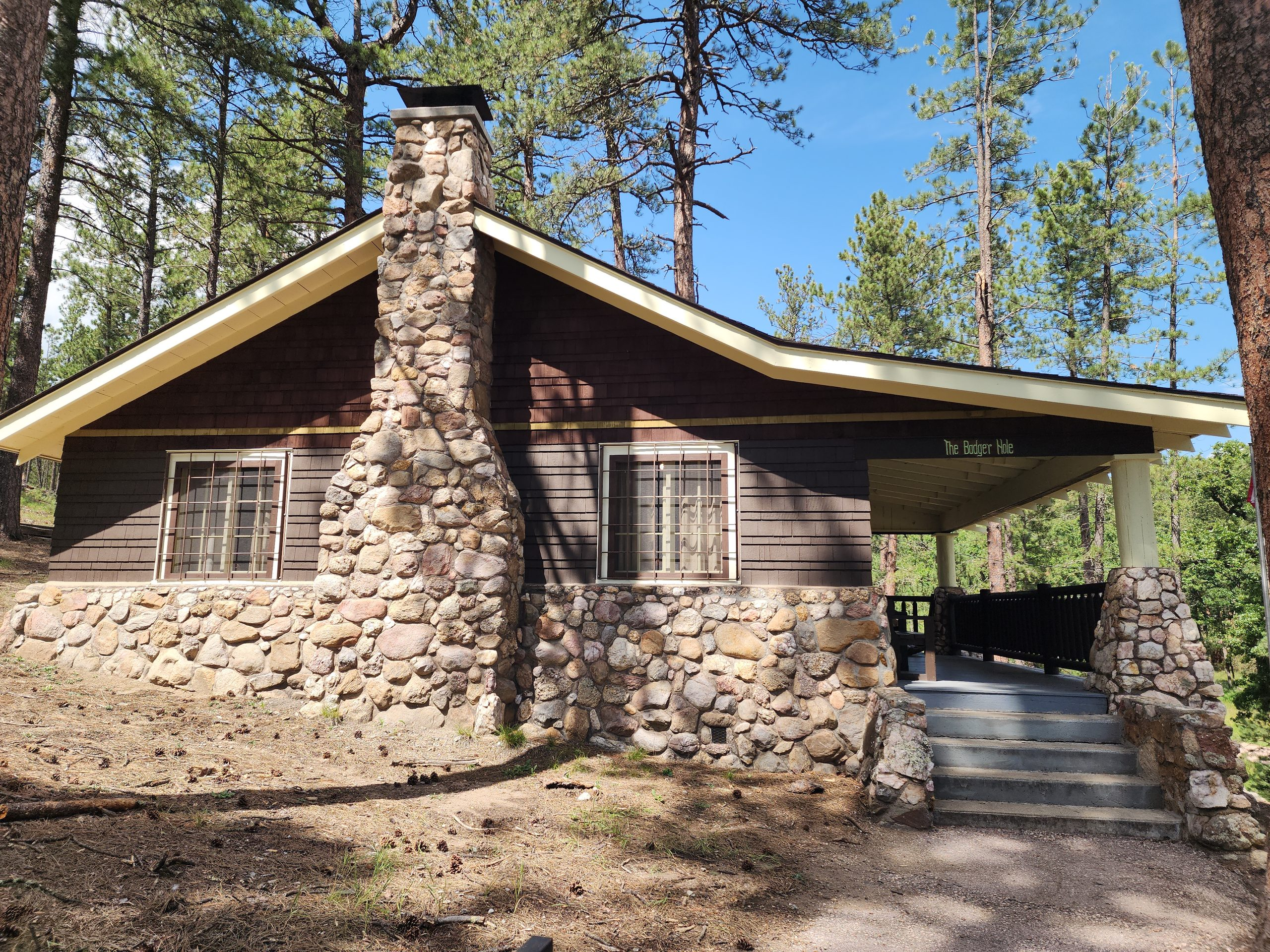
Charles “Badger” Clark’s “A Cowboy’s Prayer” has reached readers far beyond the places he called home. In Custer State Park, South Dakota, I visit the Badger Hole, his cabin near Legion Lake, to see the home behind the name.

His poetry is the reason this stop matters to me. Walking through the rooms adds another layer: the place where he cooked, slept, read, welcomed visitors, and continued writing.
The Man Behind “A Cowboy’s Prayer”

Born in 1883, Charles Badger Clark became South Dakota’s first poet laureate. His connection to cowboy life came from experience, including time working on a cattle ranch near Tombstone, Arizona.
“A Cowboy’s Prayer” belongs to those Arizona years, before his home at the Badger Hole. It later appeared in his collection Sun and Saddle Leather, first published in 1915.
The poem speaks through a cowboy who finds a connection to God outdoors. Gratitude for freedom and open country sits alongside a request to live honestly and treat other people well. Independence carries responsibility.
One passage brings those ideas together:
“Let me be easy on the man that’s down; / Let me be square and generous with all.”
That is part of what gives the poem its reach. You do not have to work cattle or ride a horse to understand wanting freedom while still caring about the kind of person you become.
His words circulated so widely that the poem was often credited to “Anonymous” or “Author Unknown.” The South Dakota Historical Society Foundation identifies that missing credit as one reason readers knew the poem without knowing Clark.
You can read “A Cowboy’s Prayer” through the South Dakota Historical Society Foundation.
A Home Among the Pines

Clark spent the final thirty years of his life in Custer State Park and lived at the Badger Hole until his death in 1957. Here, he continued writing, reading, and corresponding with people who knew his work.
From outside, the stone chimney is the first large feature of the cabin. A covered porch runs along the front, with pine trees surrounding the building.
The house also had room for company. The Historical Society Foundation describes Clark as someone who enjoyed visitors and designed his home to welcome them. Choosing a home in the woods did not mean cutting himself off from people.
Cooking, Heat, and the Work of Living Here

The kitchen brings the daily needs of the house into focus. A large cookstove stands beside a white sink, with pans hanging nearby and supplies arranged on shelves.
Clark’s home had no running water. A wood cookstove heated the kitchen, a fireplace warmed the living room, and the bedrooms were unheated. Kerosene lamps provided light during his time here.
Those details change how I look at the rooms. Meals, water, firewood, and warmth all required work alongside the writing. The stove was part of making a home function through the seasons.
The Rooms Around the Writing

In one bedroom, an iron bed sits beside a long row of leather boots. The closer view shows the creases in the leather and the wear across the toes. Seeing them lined up along the wall makes me curious about which pair he reached for most.

In another room, a dresser, mirror, guitar, and record player surround the bed. Photographs and artwork hang on the wooden walls. These belongings give me more to consider about Clark’s days here: getting dressed, listening to music, and living among pictures he chose to keep.

A small spiral notebook resting on a bed brings my attention back to his writing. I cannot tell what is inside it, but seeing it among his belongings makes me want to return to his poetry with this visit in mind.

Visiting the Badger Hole in Custer State Park
The cabin is on Badger Clark Road, south of US Highway 16A near Legion Lake. South Dakota Game, Fish and Parks currently lists interior visiting hours as 10 a.m. to 5 p.m., from Memorial Day through Labor Day.
Check the official Custer State Park historical sights page before planning around an interior visit. A drive through the park outside that season does not guarantee the cabin will be open.
Give yourself time to look at the smaller details, too. The photographs, kitchen equipment, books, and personal belongings help connect the poet’s work to the household around him.
For me, the Badger Hole gives a physical setting to a name I associate with words. I can see the rooms where Clark continued his work and the ordinary things that supported his days.
Explore More
My travels keep bringing me to places with a story behind them. Cabins like the Badger Hole, roadside art, small-town stops, and landscapes that make me want to stay a little longer.
I share what I find, the details that catch my attention, and the people whose work gives these places their character. If you enjoy coming along and find a few stops you might want to make yourself.
Fueled by coffee, road miles, and Roy’s questionable assistance. Enjoyed the read? Help keep it rolling. Buy Me a Coffee →