Some of my favorite stops on the road leave me with more to think about once I’m back in the driver’s seat. My visit to Hoofprints of the Past Museum in Kaycee, Wyoming, had me looking at the surrounding country a little differently, wondering about the lives that unfolded here long before I pulled into town.
What is Hoofprints of the Past Museum?
Hoofprints of the Past Museum preserves Kaycee and the surrounding region’s history in downtown Kaycee. Volunteers founded it in 1990. Its exhibits cover Native American history, the fur trade, the Bozeman Trail, ranching, the Johnson County War, and the area’s outlaw connections.
But you do not need to arrive knowing the names and dates. The tools, buildings, and household objects give you somewhere concrete to begin.
The collection extends into historic structures and wagon displays. Moving between them gives the visit a different rhythm from walking past a single row of glass cases.
The tools behind everyday life

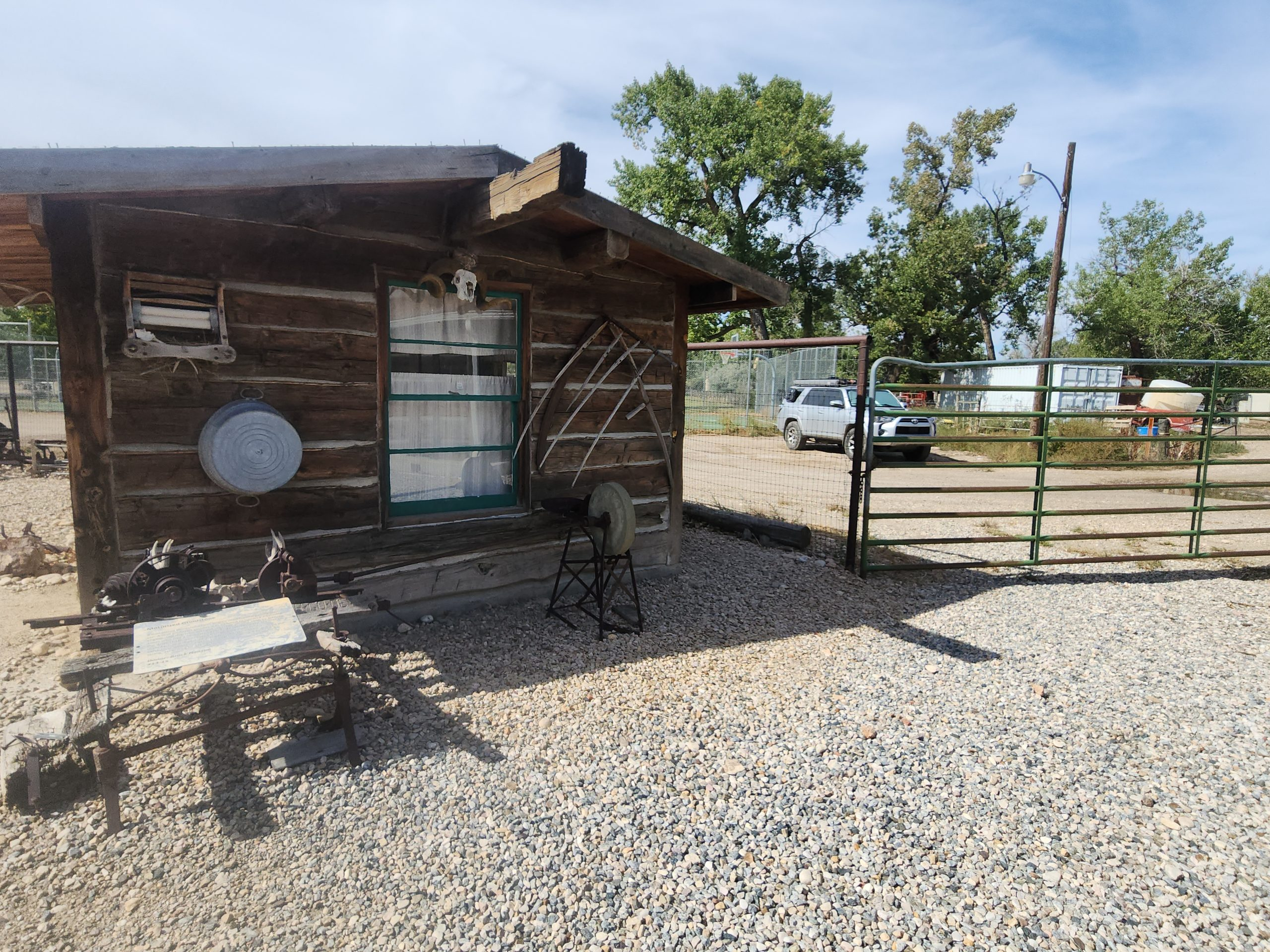
The blacksmith display brings the work of building and repairing equipment into view. Tools cover the wooden walls. Anvils, wagon wheels, and heavy equipment fill the space around a mannequin dressed for the job.
It is easy to admire an old wagon without thinking about everything required to keep it usable. This room brings the repair work back into view. Someone needed the tools, the skill, and the time to deal with a failure.
Elsewhere, shelves beneath a Kaycee Merc Co. sign hold food tins, cookware, soap, footwear, and other household items. The labels and packaging draw you closer, but the contents are familiar: food to put away, things to clean, and equipment to maintain.

Those objects make the past feel less distant. A supply run still revolves around many of the same needs, even if the containers and transportation have changed.
Inside the old schoolhouse

The museum preserves Kaycee’s first school building, dating to 1890. Inside the small log structure, student seats face a teacher’s desk, and a stove stands ready to explain one responsibility that went well beyond teaching lessons: keeping the classroom warm.
A picture frame display a paper insert titled “1922 Teacher’s Contract — $75 Per Month” introduces a much more restrictive side of the profession. The terms reach into nearly every part of a woman teacher’s life, from whom she could spend time with to what she could wear.

Under the rules listed, getting married would end her contract. She could not keep company with men or ride with a man other than her father or brother. Leaving town required permission from the chairman of the trustees. Unless attending a school function, she was expected to be home between 8 p.m. and 6 a.m.
Even her appearance came under scrutiny. The display prohibits bright clothing, dyed hair, and makeup. It specifies at least two petticoats and dresses no more than two inches above the ankles.
The work also included daily sweeping, weekly floor scrubbing with soap and hot water, and starting the fire at 7 a.m. so the room would be warm when children arrived at eight.

The insert does not identify a particular Kaycee teacher or school district, so I would not assume these exact terms governed this classroom. Still, reading it inside the schoolhouse adds another layer to the visit. Beyond the desks and lesson books is the question of what earning a living could demand of a woman’s personal freedom.
The wagons deserve a closer look

The wagons at Hoofprints of the Past Museum show how much the design of a vehicle can tell you about its job. An enclosed mail wagon, a covered living space, and an open wooden wagon may all have spoked wheels, but what they carried (and what they needed to protect) was different.
The museum’s collection includes a sheepwagon and a local chuckwagon more than a century old, along with other wagons and farm equipment. Together, they add a practical side to the region’s history. People needed ways to move supplies, support livestock work, and carry the necessities of daily life.
A sheepwagon and a familiar small space

The sheepwagon interior is the part that connects most directly with my own life on the road. There is a bed across the back, storage beneath it, narrow surfaces along the sides, and a stove near the entrance. A small table extends into the center.
There is very little room for anything without a purpose. Cooking, sleeping, and keeping the basics organized all happen within a few steps.

The museum’s sheepwagon history display explains how these mobile shelters allowed sheepherders to stay with flocks in remote places. Shelter and the ability to move were part of the work.
Living small gets presented as a new idea surprisingly often. Looking at this setup is a reminder that people were solving versions of the same space problem long before modern camper conversions.
A mail wagon with a Nebraska connection

One of the most distinctive vehicles is the black enclosed U.S. Mail wagon. Its painted lettering identifies Rural Route No. 1 in Atkinson, Nebraska, and lists the years 1910–1927. Another inscription says the first route covered 28 miles and later increased to 65 miles.
Those details give you more to consider than the wagon’s appearance alone. The enclosed body offered a protected space for the carrier and mail, while the route mileage gives some sense of the distance involved in serving rural households.
The Nebraska lettering raises another question: how did this mail wagon find its way to Kaycee? Its markings identify an Atkinson route, but further research is needed to learn how it became part of the museum’s collection.
The lambing wagon: a “Lambulance”

The open wooden lambing wagon had a very specific job. According to its exhibit sign, it was commonly called a “Lambulance.” While sheep were being trailed, it carried ewes that were lambing, their lambs, and sick or injured sheep.
The sign records that the Babson Brothers used this wagon in 1926. They once owned the TTT Ranch south of Kaycee, which donated the wagon to the museum. That history turns a weathered piece of equipment into something more specific: a way to care for vulnerable animals while the flock was on the move.
The ranch also connects the exhibit to the Johnson County War. The museum’s sign identifies it as the former home ranch of John N. Tisdale and explains that it became one of the invaders’ stops on their way toward the KC Ranch and Buffalo.
Placed alongside the sheepwagon, the lambing wagon shows another part of the same working life. The herder needed mobile shelter, and animals that could not keep moving with the flock needed transportation. The two wagons served different needs within the work of tending sheep.
Planning a visit to Hoofprints of the Past Museum
- Address: 344 Nolan Avenue, Kaycee, Wyoming 82639.
- Phone: 307-738-2381.
- Published season: May 15 through October 31.
- Published hours: Monday–Saturday, 9 a.m.–5 p.m.; Sunday, 1–5 p.m.
- Holiday closure: Independence Day.
These details were checked against the museum’s website in October 2026. Confirm current hours before making a special trip. Check directly for admission details, accessibility needs, and any arrangements for visiting outside the regular season.
The museum also lists guided historical tours. Treat those as separate plans: check upcoming dates, availability, pricing, and reservation requirements rather than assuming a tour comes with a museum visit.
Visit the official Hoofprints of the Past Museum website for updates and tour information.
A reason to spend more time in Kaycee
Some road stops give you a photograph. Others give you a better understanding of the place you have been driving through.
For me, the connection here was in the practical details. A stove positioned within reach. Storage beneath a bed. Tools kept close to the work. Ordinary objects that once helped someone handle their day.
I came away thinking about the people who used them. Long before these things became exhibits, they had jobs to do.
Sources: Museum collection information; official visitor information; exhibit labels and photographs from my visit.
See What’s Down the Road
Small towns and unexpected stops are a big part of my life on the road. I share the places I visit, the stories behind them, and the details that make a stop worth considering. Explore more of my travels for ideas to add to your own route.
Fueled by coffee, road miles, and Roy’s questionable assistance. Enjoyed the read? Help keep it rolling. Buy Me a Coffee →